


Middlemarch
George Eliot
In ancient Rome, otium was precious time reclaimed from public business (negotia) to devote to study, reading, and self-cultivation. We built a digital space that keeps that promise: library, memory, and relationship.
4.2k
reading sessions
Inside the Otium Bookshelf library
Middlemarch
George Eliot
Grandi Speranze
Charles Dickens
Il Grande Gatsby
F. Scott Fitzgerald
1984
George Orwell
L'Educazione Sentimentale
Gustave Flaubert
Il Giovane Holden
J. D. Salinger
Cent'anni di Solitudine
Gabriel García Márquez
Il Maestro e Margherita
Mikhail Bulgakov
The origin
Far from negotium.
We have lost the habit of protected time. Otium Bookshelf is a refusal of noisy interfaces: no ads, no endless feed. The monthly leaderboard and the daily practice are there, but they stay in their place: you can leave the leaderboard, and no Vestal is ever spent without your yes. Only your books, your notes, and the time you choose to devote to them.
Antiquity
“Omnia, Lucili, aliena sunt, tempus tantum nostrum est.”
For the Romans, otium was not idleness — it was time reserved for reading, reflection, the cultivation of the soul. A privilege turned into practice.
Modernity
Today otium lives in your phone. A personal library, notes on the books you read, reading progress — all in one app built for people who take reading seriously.
62%
14
books
3
notes
1.2k
pp.
Two eras. One single passion.
Otium — from Latin, the time devoted to what truly matters
Tools, not distractions
Track
Keep read, current, and future books together. Every transition stays legible, without forcing you to remember everything.
Library
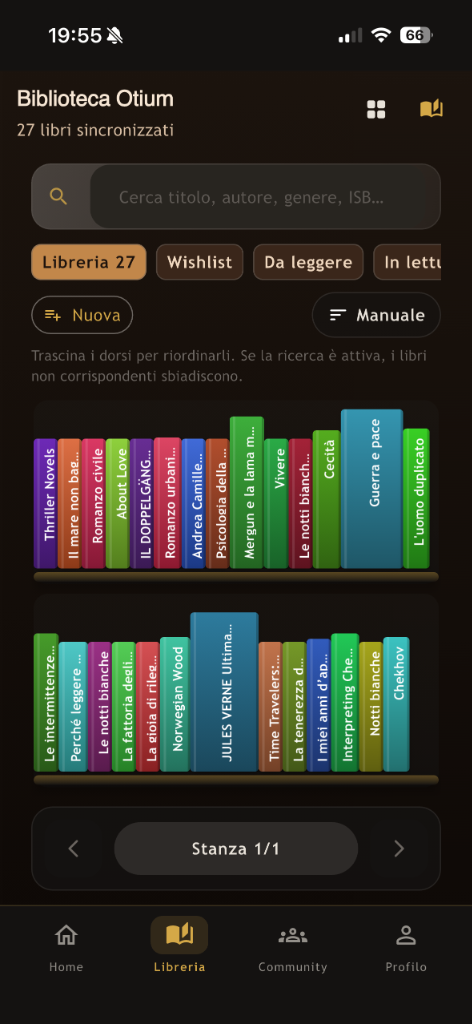
Your personal library does not stay a flat list. You can divide it into shelves, filters, themes, and priorities.
Passport
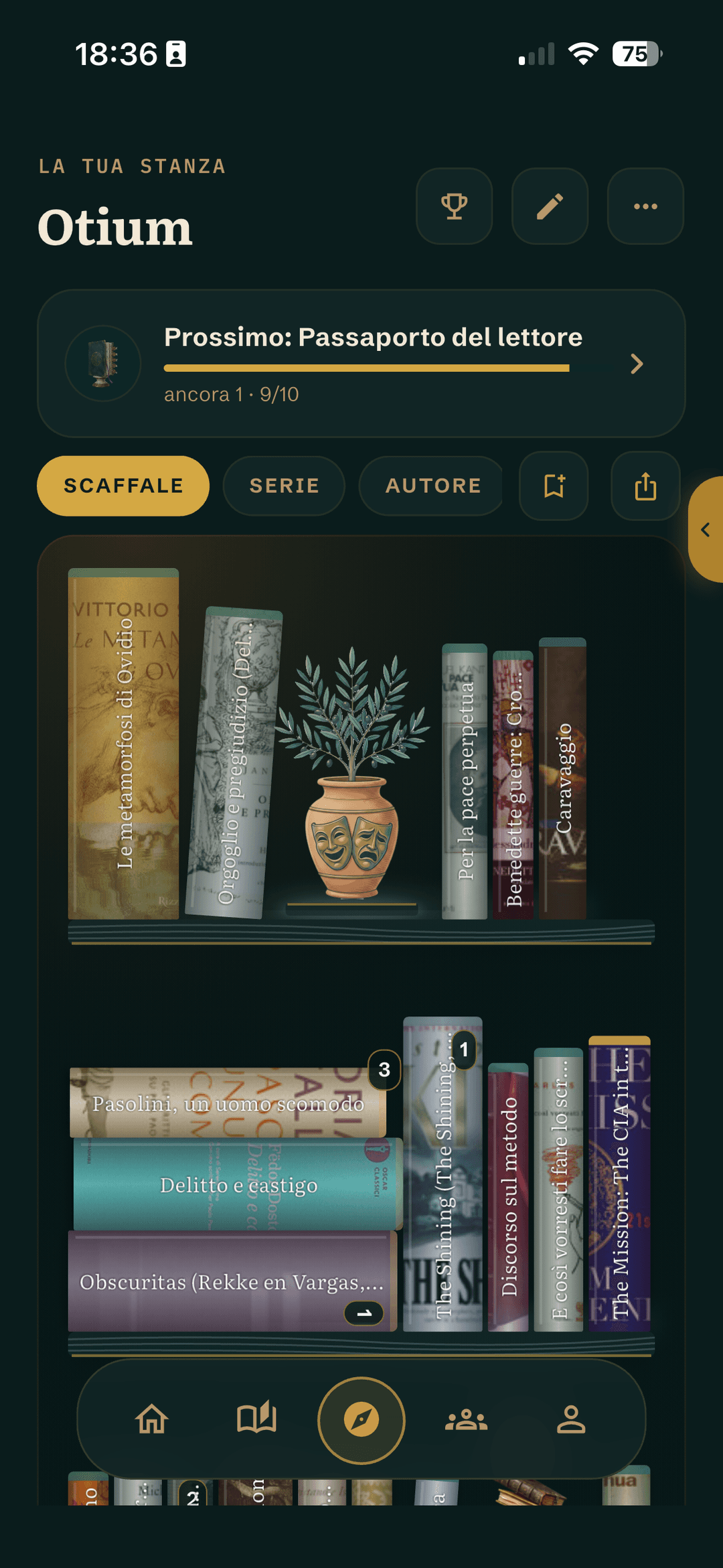
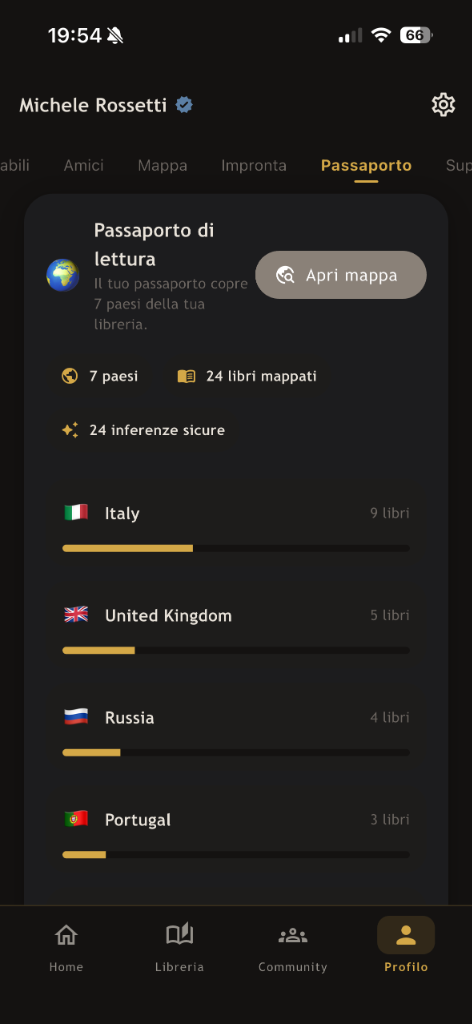
Otium Bookshelf works out the country behind every title you read and puts it on a map. The reading passport shows how far your library travels beyond home.
Fingerprint
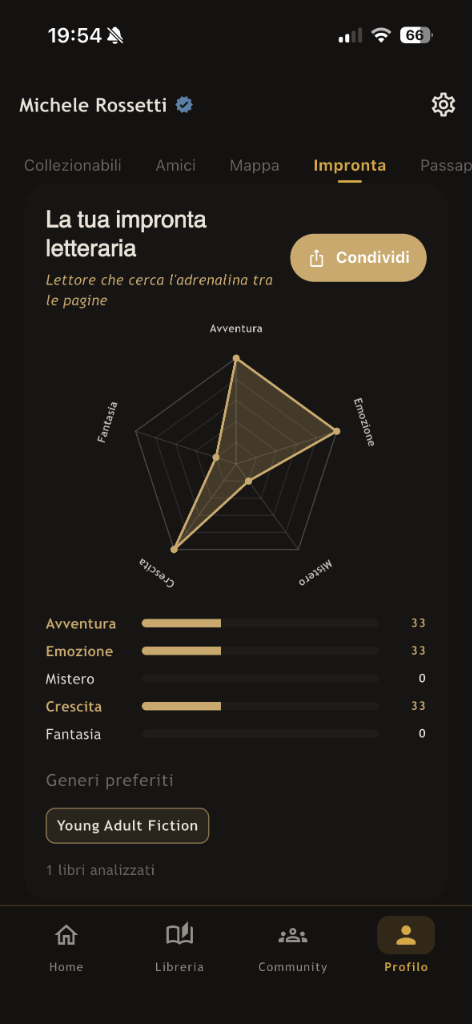
Otium Bookshelf reads your library and draws a profile across five axes: adventure, emotion, mystery, growth, imagination. The fingerprint shifts as the library grows.
Community
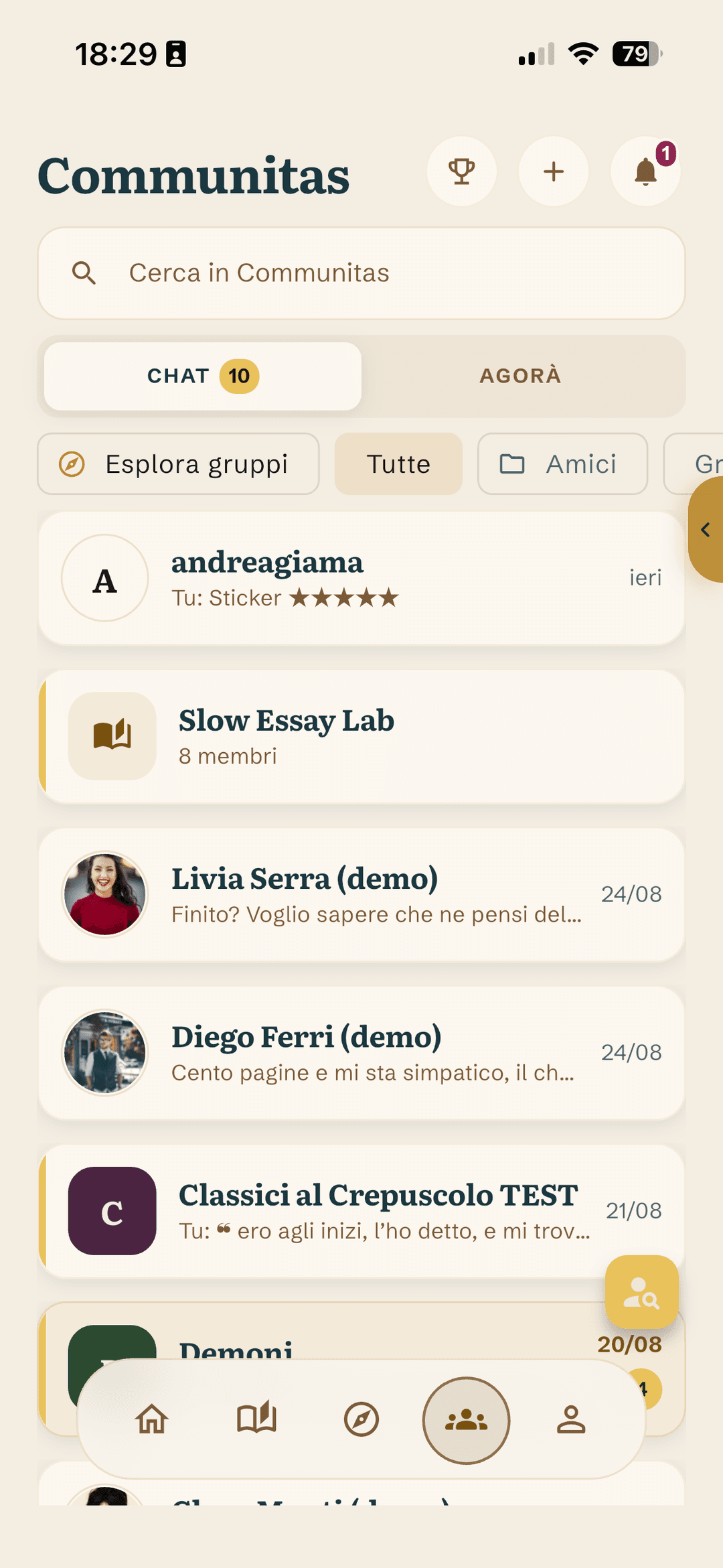
The social layer grows from books you really read: public shelves, targeted recommendations, and conversation anchored in actual titles.
In the app, today
The site tells the idea; these features are live today in the Otium Bookshelf app. Where it says Pro, they are part of the subscription.
Barcode scanning with flash and zoom, a preview and one tap to add to a shelf. With Pro, AI cover recognition reads the title, publisher and language of the edition.
A timer from the book page, with today's and all-time statistics. Goals for pages per day and books per year, with a value suggested by your library that you can change.
One check-in a day on a book you are reading. Every seven days of practice you earn a Vestal; if the streak breaks, you decide whether to spend them or start again. No Vestal is ever spent on its own.
Notes and quotes from all your books in one place, with search, tags, CSV export and a printable PDF booklet of quotes.
Record a thought next to the book; the transcription lands in the notebook as text.
A card in three formats, coloured by the book's cover, with a QR code to the book's page.
Your collection as a place: spines scaled to the real page count, stacks, objects and the trophies earned by reading. It can be published as a web page. The onyx and malachite themes are Pro.
Book clubs with chapters that unlock over time, and reading sprints shared in a room. Creating a Slow Club or a Pro Room requires Pro.
The one competitive corner, inside Communitas: the monthly readers' leaderboard, with trophies for the podium and the top 10. If you would rather not appear, leave it from your account on the website (Account › Privacy).
Home does not scroll forever: at most four sections a day, and an end. Every suggestion says why it is there, and you can turn it down.
The places of your reading on a map, and the passport of the countries your library travels through.
The year in review, notebook pages included, to share as an image. The full version is Pro.
Every month, an AI-written account of your reading. Included in Pro.
Slow Club
Intimate reading groups - never more than five readers. Shared shelves, real conversation, no noisy feed.
A Little Life
Reading - Ch. 4 of 8
Next meeting - Sunday 9:00 PM
A day in Otium Bookshelf
Track progress, save a line, rediscover a title. Without friction.
Search for a title, enter an ISBN, or build your library little by little. Otium Bookshelf works even from an incomplete collection.
You mark what you are reading, what you finished, and what you want next. Notes and quotes stay beside the right book.
When you return after days or months, you always know where you left off, what you loved, and which book to open next.

Michele Rossetti
Founder · Reader no. 1
Who is behind this
Otium Bookshelf did not start in a meeting. It started as an irritation: readings that go missing, notes you can never find again, reading time eaten by a feed that never ends.
I did not want another app for counting books. I wanted a place where reading stays put — the progress, the notes in the margin, the quotes that always vanish. I started building it for myself, and I am still the first person who opens it every day.
Otium is a Latin word and it does not mean idleness. For the Romans it was time taken back from negotia — business, noise, obligation — and returned to study and to oneself. It was a discipline, not a holiday.
That problem is not an Italian one. Everywhere, reading time is eaten by the same feed, and everywhere the same people are looking for a way to take it back. Otium Bookshelf is born in Italian but it does not stop there: the language changes, the need does not.
Enter Otium Bookshelf
Your time is precious. Use it well.
Free - iOS - Android - Web
App & Web
Whether you are on the couch with your phone or at your desk, your library and progress stay aligned and accessible.


